

Riung 17 Islands Month by Month: Weather and Sea, January to December
Riung Flores Editorial Desk 14 min read

Riung and the 17 Islands follow the general Flores/NTT climate pattern: a dry season roughly April through November (calmest and clearest in the June–September core) with calmer seas and clearer snorkeling water, and a wet season roughly December through March with more wind, rain runoff, and reduced visibility that can push boat captains to shorten routes or cancel outright. This is regional climatology rather than a Riung-specific published forecast, so treat month labels as general guidance, not a guarantee for any single date.
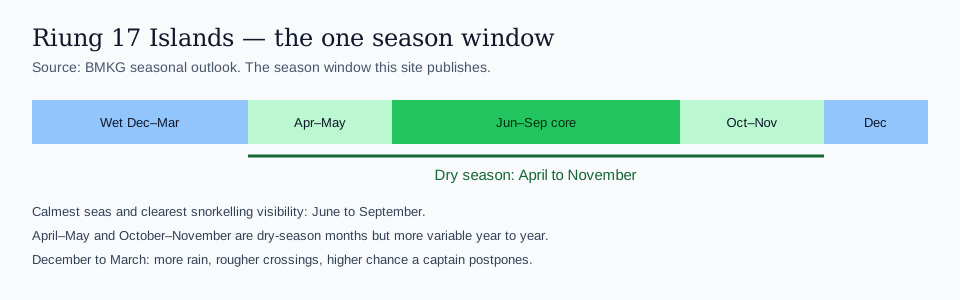

Dry season (roughly April–November, calmest June–September): the reliable window
This is the period specialist trip guides point to when they describe Pulau Bampa’s best visibility, and it’s also when local bus and boat schedules are least likely to be disrupted by weather. Expect calmer mornings, clearer water for snorkeling, and generally more predictable departure times from Riung harbour. This is also, unsurprisingly, when Flores overland travel in general is at its most comfortable, since the Trans-Flores highway and rural roads around Bajawa and Riung are less affected by rain.
Wet season (roughly December–March): more variable, sometimes cancelled
Rain runoff and wind reduce water clarity, and rougher seas give captains more reason to shorten a route or cancel a boat day entirely. If you’re traveling in this window, build slack into your schedule rather than a tight same-day itinerary, and confirm with your boat operator or guesthouse the morning of your planned trip rather than assuming a booking made in advance guarantees calm conditions.
| Period | Months | What to expect |
|---|---|---|
| Dry season (core) | ~June–September | Calmest seas, clearest snorkeling water, most reliable boat departures |
| Dry season (shoulder) | ~April–May, ~October–November | Dry-season-classified but more variable year to year than the June–September core |
| Wet season | ~December–March | More wind and rain runoff, reduced visibility, higher chance of a shortened or cancelled boat day |
Terakhir diperbarui: 25 Agustus 2026. These are general NTT/Flores climate patterns, not a Riung-specific meteorological forecast. For a specific travel date, check a current weather forecast closer to departure rather than relying on seasonal averages alone.
Month-by-month planning calendar
This calendar applies the general NTT/Flores dry-wet pattern to each calendar month. It is a planning guide built from regional climatology, not a month-specific published forecast for Riung itself — always check a near-term forecast before a specific trip date.
| Month | Typical pattern | Boat-day outlook |
|---|---|---|
| January | Wet season | Higher chance of wind/rain disrupting routes; build a buffer day |
| February | Wet season | Same as January; confirm conditions locally before committing to a tight schedule |
| March | Wet season, tapering | Still variable; some calmer stretches possible |
| April | Dry season begins (shoulder) | Dry-season-classified but more variable year to year than the June–September core; still check forecasts |
| May | Dry season (shoulder) | Generally improving; more reliable than April but still short of the June–September core |
| June | Dry season (core) | Calmest seas, clearest snorkeling water — start of the most reliable stretch |
| July | Dry season (core) | Same reliable conditions; a popular month for Flores travel generally |
| August | Dry season (core) | Peak dry-season conditions; among the most reliable months for a full-route boat day |
| September | Dry season (core) | Still within the calmest, most reliable window |
| October | Dry season (shoulder) | Dry-season-classified but more variable than the June–September core |
| November | Dry season (shoulder), transitioning | Still dry-season-classified early in the month; wet season sets in progressively, more variable than the core |
| December | Wet season begins | Higher chance of disrupted routes; plan flexibly |
Does “best time to visit” mean the same thing for crowds as it does for weather?
Not necessarily. Riung, unlike Labuan Bajo or Bali, is not documented as a high-volume mass-tourism destination with a sharply defined “peak season crowding” problem — its remoteness and the overland-only access through Bajawa or Ende naturally limit volume regardless of month. The weather calendar above is the more decision-relevant factor for planning a Riung trip than crowd avoidance, which matters far more for Komodo National Park’s more heavily visited sites.
Why this is the one “best time” article that should exist for Riung
This site previously carried several competing pages about “the best time to visit Riung,” each proposing a different seasonal window without much distinguishing intent. This page is the consolidated version: a month-by-month weather and sea-conditions calendar, which is a genuinely different, more specific intent than a generic itinerary or comparison page. If you arrived here from an older Riung Flores page about August weather or a general “visiting in August” guide, this page is the current, maintained version of that information.
How this affects your Riung boat day plan
If your travel dates fall in the dry season, you can plan your itinerary with reasonable confidence in a full day’s route, including a Pulau Bampa snorkeling stop timed for its best morning visibility — see our boat tour guide for the realistic hour-by-hour version. If your dates fall in the wet season, build a buffer day into your Riung stay in case a boat day needs to be rescheduled or shortened, and manage expectations for water clarity accordingly — our snorkeling spots guide covers which stops are worth prioritizing if your day is cut short.
Planning a longer trip around the calendar
If you’re combining Riung with Komodo National Park or a longer Flores route, the same broad dry/wet pattern applies further east, though Komodo’s specific microclimate and current patterns differ in detail — see our Komodo National Park guide for that side of the trip, and our 10–14 day Flores itinerary for how to sequence a longer trip around both destinations’ weather windows.
What “wet season” actually changes about your day, practically
It’s worth being specific about what wet-season conditions change, rather than leaving it as a vague warning. Wind chop makes the boat ride itself rougher and can extend transit time between islands. Rain runoff from Flores’ hills clouds nearshore water, which most directly affects snorkeling visibility at reef stops like Bampa. Rough seas are the main reason a captain would shorten a route or cancel outright — not the rain itself, which a covered boat handles fine, but the sea state it can produce. None of this means a wet-season Riung trip is a bad idea; it means building in flexibility and lower expectations for underwater visibility specifically, while topside activities (the village walk, Bukit Latung, a Torong Padang trek) are less weather-sensitive.
If your dates are fixed and fall in the wet season
Confirm with your guesthouse or boat contact a day or two ahead rather than the morning of, so you have time to adjust plans if conditions look rough. Consider treating the boat day as the flexible part of your Riung stay and scheduling land-based activities (Bukit Latung sunset, the village, a Torong Padang trek) on the days most likely to have poor sea conditions, saving the calmest-looking day for the boat itself.
Frequently asked questions
What is the single best month to visit Riung 17 Islands?
No single source we found names one definitive “best month” — the reliable guidance is the broader dry-season window, roughly April through November, with the calmest and clearest conditions in the June–September core, rather than one specific month standing out above the rest.
Can boats still run during the wet season?
Yes, generally, but with more variability — expect a higher chance of shortened routes or same-day cancellation in rough weather, and confirm with your operator on the day rather than assuming a fixed schedule.
Is Riung crowded during Indonesian school holidays or Christmas/New Year?
We have not found specific crowding data for Riung during these periods. Given its remote, overland-only access, it is reasonable to expect lower crowd volume than more accessible destinations like Labuan Bajo even during Indonesian peak travel periods, though this is inference rather than a documented statistic.
Sources
- BMKG press release — 2026 dry-season outlook — the national meteorological agency’s 2026 dry-season timing for NTT, the basis for the window above
- BMKG seasonal prediction — dry season 2026 — BMKG’s underlying seasonal-zone forecast data
- Taman Laut 17 Pulau Riung (Indonesian Wikipedia) — background on the marine park this seasonal guidance applies to
When considering the ideal month for exploration, understanding the sea conditions is crucial for a smooth trip. Planning a visit to the 17 Islands is best executed on the water, and Komodo Luxury offers various marine excursions or extended sailing journeys. Review their available vessels to match your timing with the best possible on-water experience.
Practical patterns: how Riung weather by month changes your day
On the ground, the calendar translates into a few repeatable patterns: how early boats leave, which islands crews suggest, how often itineraries are cut short, and how much flexibility you need if you care about specific viewpoints or long snorkel stops. Treat the outline below as a planning tool, then confirm exact sea conditions locally a day or two before you go.
If you are comparing Riung 17 islands January weather with, say, September, remember that local skippers lean conservative when the wind picks up. The same group who happily run you out to far-flung sandbars in August may suggest a shorter loop in February, even if it still looks swimmable from the pier. That is not overselling risk; it reflects fuel, time and passenger comfort.
For context on currents, underwater clarity and why the dry months are usually labelled the best time visit Riung 17 islands, read the separate guide to Riung 17 Islands sea conditions, then layer the month-by-month notes below on top of that baseline. If you also care about which specific islets are inside the park boundary, the status and map details sit in the article on 17 Islands Marine Park size and islands. For a broader view of Riung town, overland access and costs, the main orientation page is the complete guide to Riung 17 Islands.
Is Riung in January still worth it if I mainly want snorkelling?
Riung in January sits in the wetter, more variable part of the year, but it can still work if you build in slack. Expect softer visibility from runoff after heavy rain and a higher chance of choppy sections. Aim to go early in your stay, let your skipper pick leeward reefs, and accept that the day may be cut shorter than in August.
How risky is a Riung 17 islands December trip for cancellations?
December overlaps the start of the wet, windier pattern, so Riung in December rainy season has a noticeably higher cancellation chance than June to September, but not a guaranteed write‑off. Early December often feels like a shoulder month; late December can bring more frequent squalls. Keep at least one backup day, avoid tight onward transport, and confirm conditions at the harbour each morning.
What should I expect from Riung in March if I want one full boat day?
Riung in March is typically the tail of the wet period. Seas are often easing back compared with January, but showers and cloudbursts still pass through. For Riung in March best month arguments, it loses out to the June–September core, but it can be a fair compromise if you want greener landscapes inland and are willing to shuffle days to catch the calmest window.
Is Riung in January best time for avoiding crowds even if the sea is rougher?
Yes. If your priority is solitude rather than perfect clarity, Riung in January usually brings the quietest mix of harbour, islands and guesthouses. Boat prices per vessel stay similar, but you are more likely to have favourite snorkel spots to yourself. Just remember that the calmest water still falls in the mid‑year dry‑season core, not this shoulder.
What is the best season to visit Riung 17 islands for a long snorkel-focused trip?
If you can choose freely, the best time to visit Riung marine park for repeated snorkel days is the June–September window. Winds and runoff are generally lowest, giving clearer water and more stable surface chop. This is also when multi‑day stays are most forgiving, because you can shuffle which day you dedicate to the marine park without worrying as much about total washouts.
How do I decide the Riung 17 islands best month if I also care about inland Flores scenery?
Travellers who want both coast and highland views often compromise on May or October. These shoulder months can deliver mostly dry boat days with slightly more cloud and a fresher, greener interior compared with the driest core. They are not as predictably glassy as July, but if you value Bajawa volcano views as much as reef visibility, they are a good balancing point.
Which are the best islands to visit in Riung in the wetter months versus peak dry season?
In the dry season, crews happily stretch to more exposed spots and tiny sand cays. During wetter spells, skippers may favour leeward bays with mangrove shelter and easier re‑boarding in small chop. They still cover headline stops like Ontoloe for bats and popular snorkel reefs, but the exact loop changes with wind direction and swell on the day rather than a fixed brochure circuit.
How does planning change if Riung in December is my only option for a Flores overland route?
If your overland dates are fixed around Christmas, treat Riung in December as a flexible target rather than a single locked‑in boat day. Arrive with two or three nights, tell your guesthouse your preferred order of activities, and be ready to reverse days if a squall line moves through. You may still get a calm outing; the key is holding your transport connections loosely.
Once you have used this month‑by‑month guide to lock in the best time to visit 17 Islands Marine Park, the next step is deciding whether to keep things entirely local or to fold Riung into a wider liveaboard leg. If you want a shared-boat Komodo add‑on, look at the Komodo Luxury open trip departures; for flexible private charters, compare their Komodo liveaboard options or shorter 3D2N itineraries.
Practical Timing for a Riung Boat Trip
What is the key takeaway on the Riung Flores climate?
The core pattern for the Riung climate is a pronounced dry season from roughly April to November. Within this window, the period from June to September typically offers the calmest seas and best underwater visibility, making it the most reliable time for boat trips. The wet season, from about December to March, brings more frequent wind and rain runoff that can degrade water clarity and lead to trip postponements or cancellations by captains concerned with safety and guest experience.
Is a February boat trip at Riung possible?
A February boat trip is possible but not guaranteed, as this month is in the middle of the wet season. It is a gamble on daily conditions. While some days may be perfectly clear, there is a significantly higher probability of rain, wind, and rough seas that reduce snorkeling visibility or cause captains to cancel entirely. Operators make the final decision based on safety on the morning of departure. If visiting, maintain a flexible itinerary and confirm with your operator on the day.
Keep reading
Uncategorized 11 min
Riung 17 Islands: What Changed for 2027
What's changed for Riung travel planning, most recent update first: a magnitude 7.7 earthquake struck north Flores on 15 August…

Uncategorized 11 min
Riung 17 Islands Solo Travel: Joining a Shared Boat
Riung 17 Islands as a solo traveller: the most cost-effective route is joining an existing group's shared boat rather than…

Uncategorized 11 min
Can You Dive at Riung 17 Islands?
Can you dive at Riung 17 Islands? No - there is no PADI dive centre or scuba operation based in…